
Cambridge & Global Education
December 20, 2025 2026-01-28 15:56Cambridge & Global Education
Cambridge Pathway at DPS Greater Faridabad
A global curriculum, thoughtfully rooted in Indian ethos.
Beginning with the academic session 2026-27, DPS Greater Faridabad will roll out admissions for the Cambridge curriculum starting with Cambridge Early Years and Cambridge Primary. This pathway brings a globally recognised curriculum and assessment framework to our existing CBSE strength, giving learners the advantage of an international education while staying connected to the cultural foundation of India.
OUR PHILOSOPHY
WHY CAMBRIDGE AT DPS GREATER FARIDABAD?
Cambridge is built for an increasingly interconnected world. The curriculum is structured to support learners who may pursue higher education or careers in India or overseas, offering continuity, flexibility and global relevance.
For families who may relocate internationally, Cambridge ensures smoother transitions, as the curriculum structure, assessment philosophy, and classroom approach remain consistent across countries.
The Cambridge curriculum is regularly reviewed and updated in line with international educational research and evolving global skill requirements. It prepares students not only for present academic expectations, but for the realities of future university learning and professional environments.
Cambridge follows a clear, adaptable curriculum framework that schools can tailor to their local context. Learning progresses in a coherent, age-appropriate manner, ensuring strong conceptual foundations, academic depth and clarity at every stage of schooling.
Cambridge qualifications are recognised and valued by leading universities worldwide, supporting study opportunities in India and internationally.
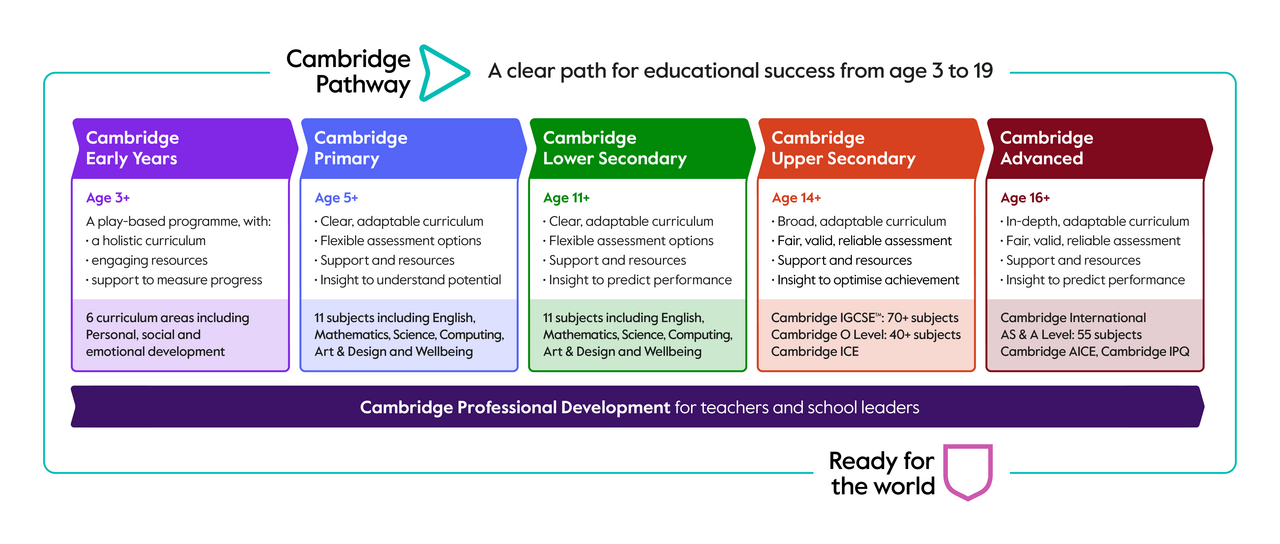
THE CAMBRIDGE PATHWAY
LEARNING IN A CAMBRIDGE CLASSROOM
Each Cambridge classroom includes thoughtfully designed work stations for inquiry, problem-solving, reading, experiments, and creative expression. Students move through these zones to explore concepts from multiple angles.
Students are encouraged to ask questions, explore ideas and examine real-life contexts rather than only preparing for tests.
The focus is on why and how, not just what. Learners work on applying concepts to unfamiliar situations
Assessment focuses on ongoing formative assessment, classroom-based feedback, and optional Cambridge Progression Tests and Checkpoint assessments.
Topics and case studies may include international examples, but classroom conversations always relate back to India’s culture, society and contemporary issues, preserving context and ethos.


